
TekMatix Blog & Help Articles
Use the search bar below to look for help articles you need.
How to Use the New HubSpot Integration in Tekmatix
HubSpot Integration for Tekmatix Workflows

HubSpot is the CRM platform used by sales, marketing, and service teams to track contacts, companies, deals, and tickets. The HubSpot integration brings HubSpot directly into the Workflow Builder so customer-facing automations can react to new contacts and the other way around. One instant trigger and five actions cover the most common contact-centric operations: creating, finding, looking up by ID, searching by email, and associating contacts with companies or deals.
About the Integration
The integration ships with two halves:
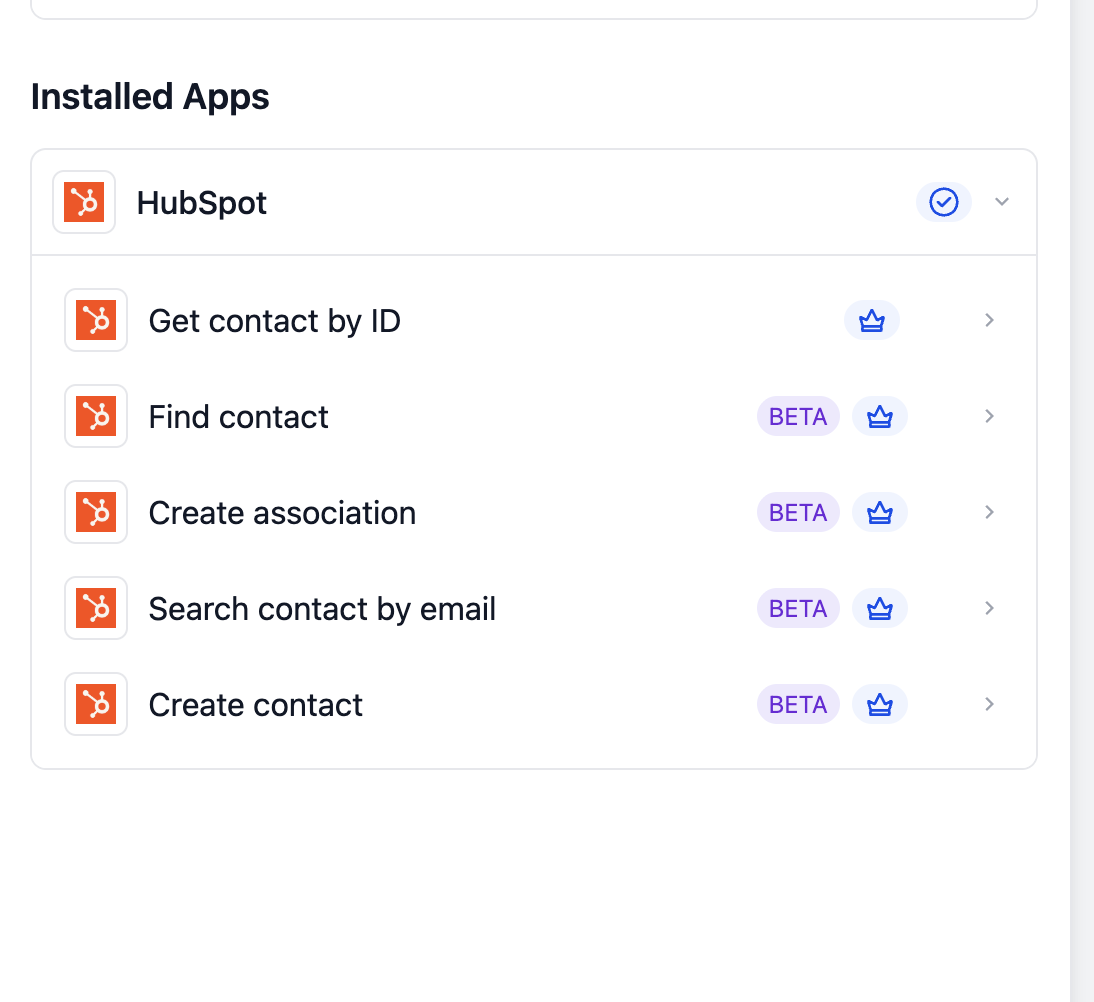
Trigger (HubSpot → Workflows): One instant trigger - New Contact Created.
Actions (Workflows → HubSpot): Two actions - Create Contact and Find Contact
Trigger and actions are premium features
How to Set Up HubSpot
Before any HubSpot trigger or action can run, the integration has to be connected. The connection allows your workflows to securely read from and write to your HubSpot portal.
Connect via the Workflow Builder (recommended)
Open Automation → Workflows and pick (or create) a workflow.
Add a HubSpot trigger or action — search for HubSpot in the Apps tab.
Select any HubSpot trigger or action.
On the action card, click Connect Now.
Sign in to HubSpot via OAuth when prompted; authorize the portal and the scopes the integration requires (Contacts: read/write, Associations).
Click Save to complete.
Connect via Settings (alternative path)
Go to Settings → Integrations.
Locate HubSpot and click Connect.
Authenticate via OAuth and authorize the portal.
List of Triggers
This release ships with a single trigger. Additional triggers (deal stage, ticket events) are on the roadmap.
New Contact Created - Fires when a new contact is created in HubSpot. Returns the full contact payload standard and custom properties.
List of Actions
Create Contact - Creates a new contact in HubSpot. Standard fields: Email, First Name, Last Name, Phone. Custom properties supported.
Find Contact - Looks up a contact by Record ID, email, or filter. Returns matching contact(s) for downstream branching.
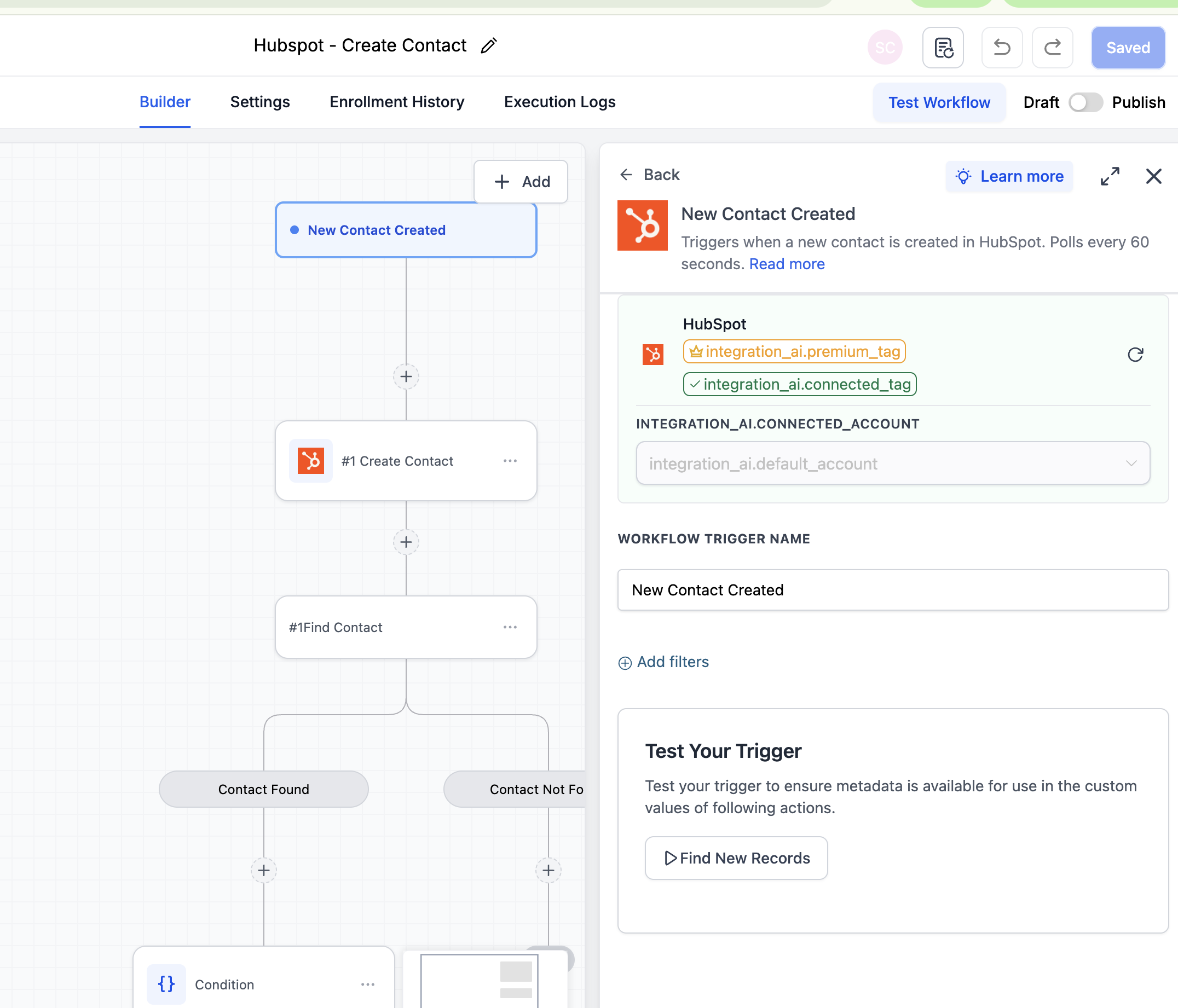
Example: Setting Up a Trigger (New Contact Created)
This walkthrough wires up a workflow that fires every time a new contact is created in HubSpot — and uses the contact payload as the source of all downstream actions.
Step 1: Add the trigger
Open the workflow and click Add Trigger.
Switch to the Apps tab and search for HubSpot.
Select New Contact Created from the HubSpot trigger list.
Step 2: Configure the trigger
Workflow Trigger Name — give it a meaningful label such as ‘New HubSpot Lead’.
Filters (optional) — constrain by lifecycle stage, source, or any contact property so unrelated contacts don’t enroll.
Step 3: Test the trigger
Click Find New Records inside the Test Your Trigger panel.
The system fetches the most recent matching contacts from HubSpot.
In the Records — Select Mapping Reference dropdown, pick one of the returned records. This locks the payload schema so downstream steps can map cleanly.
Click Save Trigger to finish.
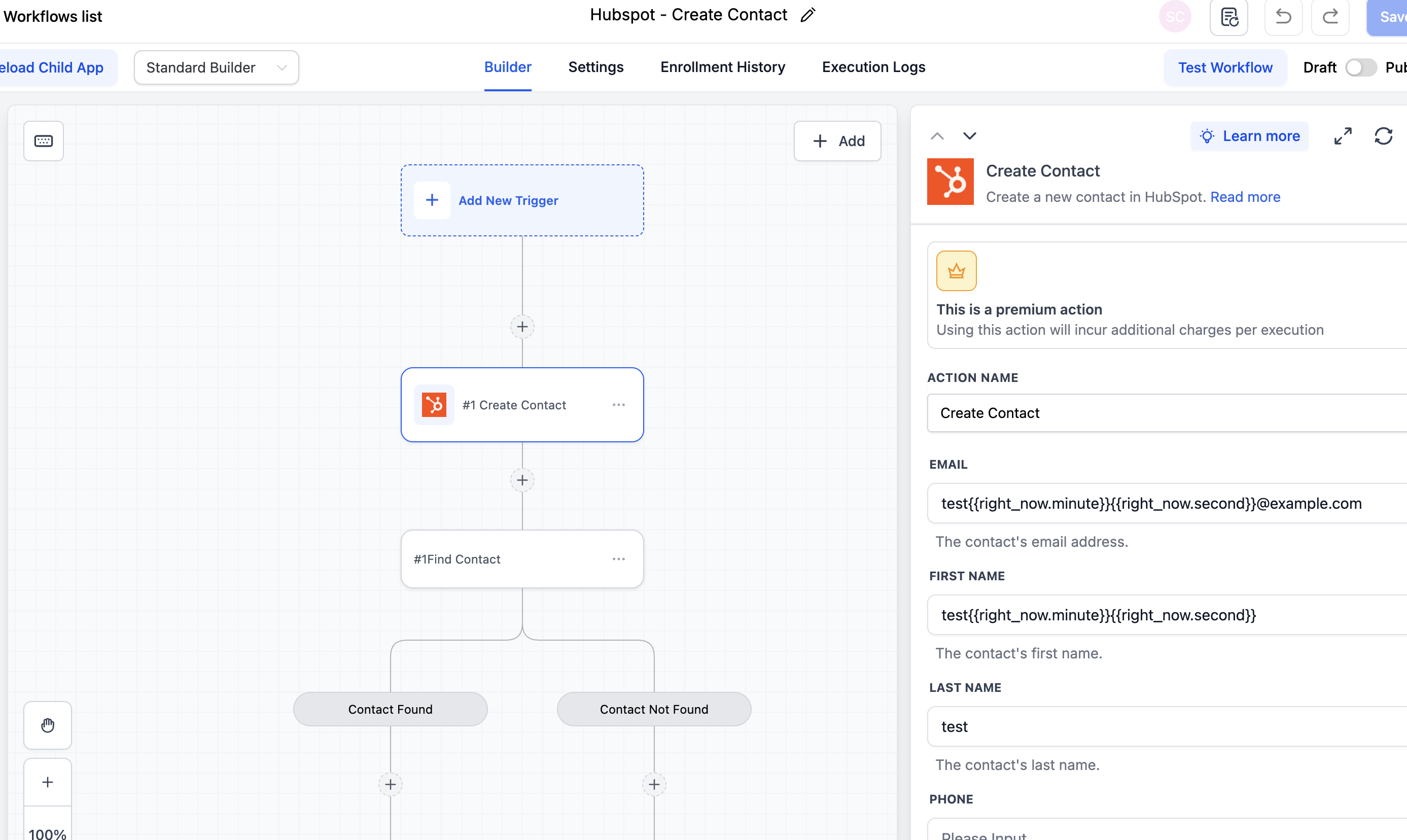
Example: Setting Up an Action (Create Contact)
This walkthrough creates a HubSpot contact from a form submission — the most common inbound-flow shape.
Step 1: Add the action
Inside the workflow, click Add to insert a new step.
Open the Apps tab and select HubSpot.
Choose Create Contact from the action list.
Step 2: Connect (first time only)
If the integration is not yet connected, click Connect Now on the action card.
Authenticate via HubSpot OAuth and authorize the portal.
Step 3: Configure the action
Action Name — give the step a meaningful label such as ‘Create HubSpot Contact’.
Email (required) — use an inline workflow variable, e.g. {{contact.email}}. Email is the canonical dedup key in HubSpot.
First Name — map from the contact or form payload, e.g. {{contact.first_name}}.
Last Name — map from the contact or form payload.
Phone — optional. Map from the contact record or form field.
Custom properties — any property defined on the HubSpot Contact object can be mapped here. Define it in HubSpot first; unknown property names are silently dropped on submit.
Step 4: Always run Search Contact by Email first
To prevent duplicates, place a Search Contact by Email step before Create Contact, then branch: if found, use the existing record (or skip); if not, run Create Contact. Email is the canonical dedup key in HubSpot, and this two-step pattern is the single most important hygiene rule for inbound CRM flows.
Step 5: Save and use the output
Click Save action. The new contact’s ID and full record are exposed as workflow output variables. Chain a Create Association step right after to link the contact to a Company or Deal if account-based context matters.
How to Test the Trigger and Action
Always test before publishing. Testing locks the payload schema and gives downstream steps a real record to map against.
Test the trigger
Inside the trigger panel, click Find New Records.
Select a recent contact as the mapping reference.
Confirm the Trigger Data Response panel shows the fields you plan to use.
Test the action
Inside the action panel, click Test Action.
The action runs against the live HubSpot portal using sample values.
Verify the contact appears in HubSpot at the expected properties.
If wrong, re-check the field mapping (especially custom property names) and re-test. Once happy, click Save action, then run a full Test Workflow before publishing.
Common Use Cases
Use Case 1: Form-to-Contact with Dedupe
Goal: Capture inbound leads into HubSpot without creating duplicate contacts.
Workflow Setup:
Trigger: Form Submission
Action: Search Contact by Email
Conditional: If found → skip Create; if not found → continue
Action: Create Contact (with form payload mapped into Email, First Name, etc.)
Action: (Optional) Create Association to a Company or Deal
Example: A prospect submits a contact form. The workflow checks HubSpot for the email; if a record already exists, it skips the Create step. If not, it creates a new contact, optionally associates them with a known company, and routes them into a welcome sequence.
Use Case 2: CRM → Workflows Two-Way Contact Sync
Goal: Mirror every new HubSpot contact into the platform CRM and keep the records aligned.
Workflow Setup:
Trigger: New Contact Created (HubSpot)
Action: Find Contact (platform side, by email)
Action: Create/Update Contact (platform side) with HubSpot data
Example: Whenever a contact lands in HubSpot — from a HubSpot form, a sales rep’s manual entry, or another integration — it mirrors into the platform CRM with email, name, phone, and lifecycle stage in lockstep.

Copyright © 2026 TekMatix. All rights reserved | [email protected]